




Description
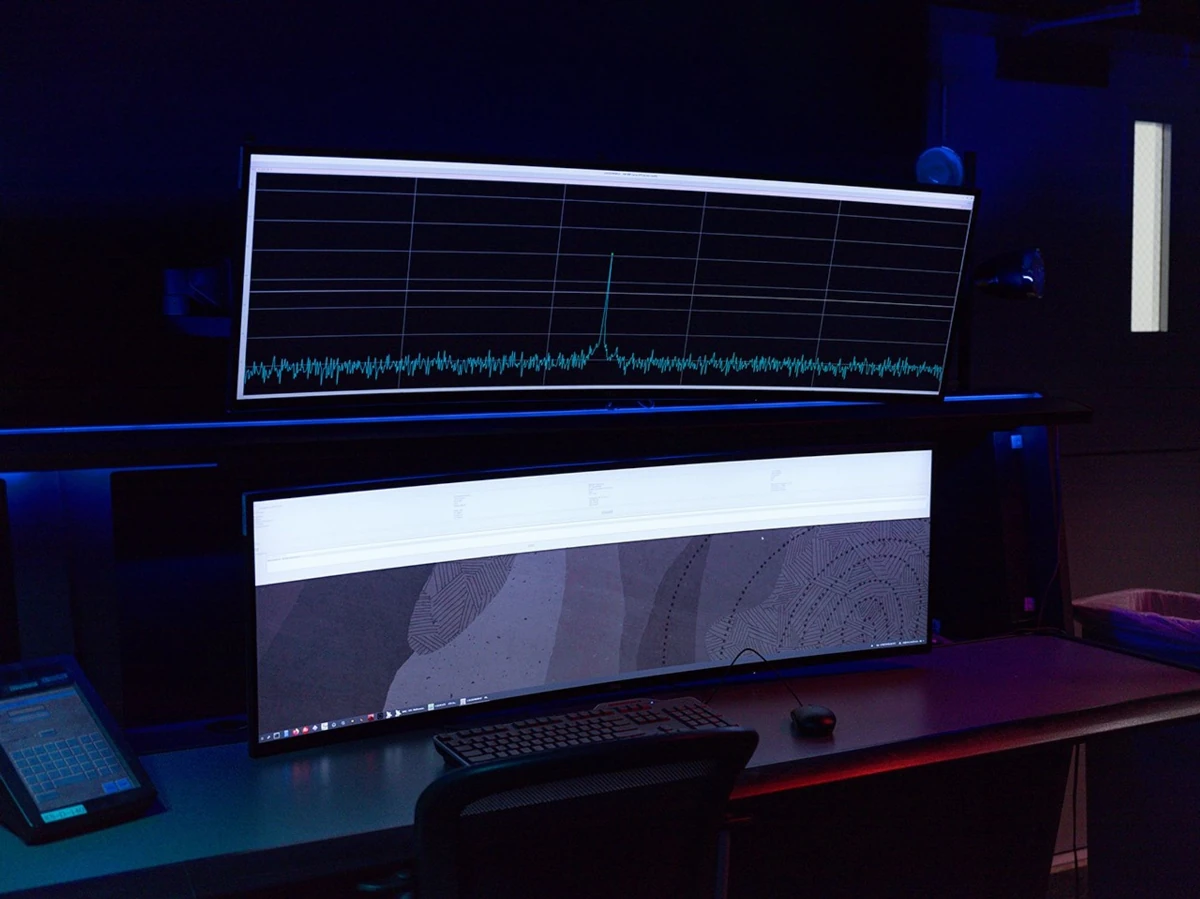
The acquisition of the radio frequency signal from the Artemis II crewed mission to the Moon by NASA’s Deep Space Network (DSN) is indicated by the peak in the data signal shown on the top computer screen.
Soon after the mission’s launch on April 1, 2026, at 6:35 p.m. EDT, NASA’s Near Space Network led communications with the Orion capsule. Then, communications were handed off to the DSN, marking the first time in over 50 years that the network would be communicating with a crewed spacecraft traveling through deep space.
The Space Flight Operations Facility at NASA’s Jet Propulsion Laboratory in Southern California (where this photo was taken) operates the DSN, which comprises three complexes in Goldstone, California; Madrid, Spain; and Canberra, Australia. Each complex consists of several radio frequency antennas that communicate with dozens of robotic spacecraft exploring the solar system in addition to the Artemis II mission.
The DSN is managed by JPL for the agency’s Space Communications and Navigation program, which is located at NASA Headquarters within the Space Operations Mission Directorate. The DSN allows missions to track, send commands to, and receive scientific data from faraway spacecraft. JPL is managed by Caltech in Pasadena, California, for NASA.
For more information about Artemis II, visit: https://www.nasa.gov/mission/artemis-ii/
About The Author


Got a Questions?
Find us on Socials or Contact us and we’ll get back to you as soon as possible.