



Astrolight, a Lithuanian space and defense company developing laser communication solutions across space, ground, and maritime domains, and ATMOS Space Cargo, a European company developing space return logistics, have signed a memorandum of understanding to jointly demonstrate what they aim to make the first in-flight optical communications link between a re-entry spacecraft and an orbiting satellite. The demonstration is planned for 2027.
During the mission, Astrolight’s ATLAS-X laser communication terminals are planned to fly onboard both ATMOS’ PHOENIX re-entry vehicle and the satellite used for the test to demonstrate a spacecraft-to-satellite optical link, enabling real-time transfer of system and mission data during in-orbit operations and re-entry at up to a 2.5 Gbps rate.
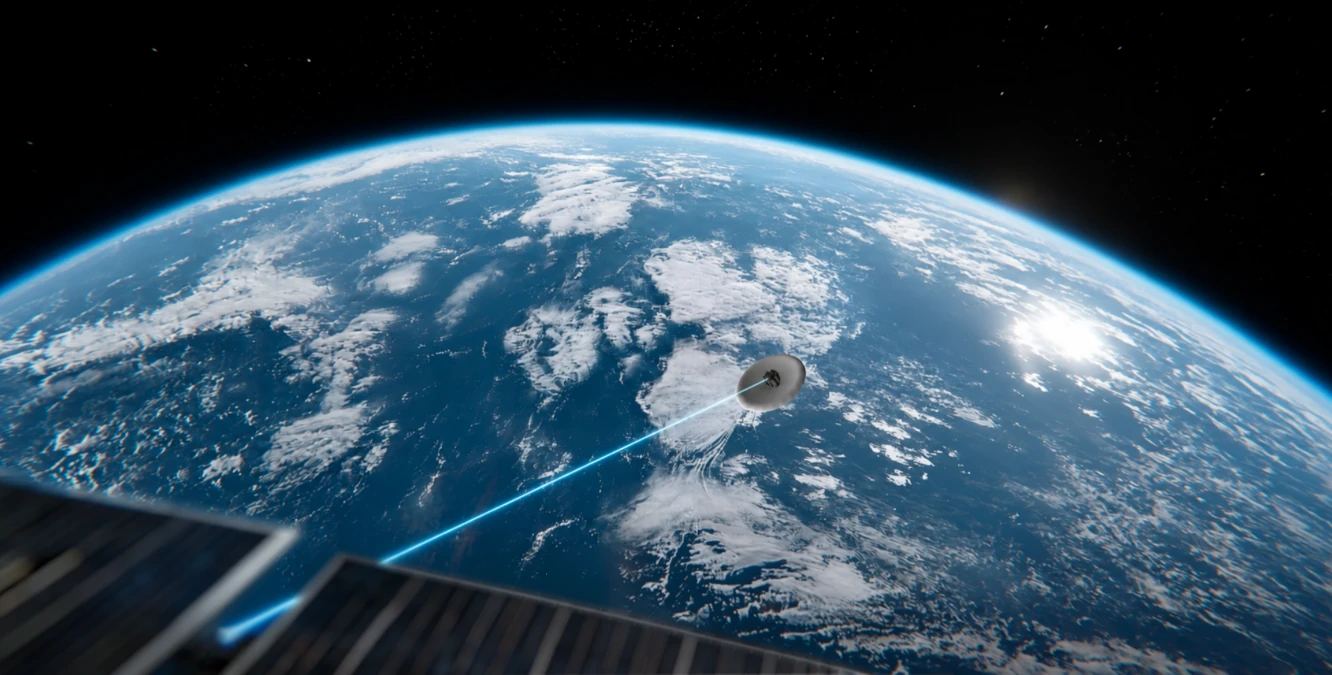
Operational schematic of the joint demonstration involving LEO satellites, the PHOENIX 2 re-entry vehicle, and ground mission control. Source: ATMOS Space Cargo.
Cargo re-entry missions are opening new commercial opportunities, from returning scientific samples, in-orbit manufactured products, and critical hardware to supporting defence, Earth observation, disaster response, and future in-space logistics. As these missions become more frequent, maintaining real-time, reliable communications throughout atmospheric re-entry is becoming increasingly important, especially in cases when conventional radio-frequency telemetry degrades. For ATMOS, real-time optical downlink is built into the PHOENIX system architecture to establish a continuous data channel through the re-entry phase, giving insight into vehicle health, guidance, de-orbit performance, and payload data before the vehicle is physically recovered – opening a path towards routine, autonomous return operations.
Laser communication is well-suited to provide the real-time and reliable connectivity these missions require. Its narrow, focused beams can transmit data at rates up to 100 times higher than traditional radio frequency and are far more difficult to jam, intercept, or detect.
“Testing a laser link between PHOENIX and an orbiting satellite will mark an important first for re-entry communications. Until now, this capability has only been explored in ground-based laboratory conditions. Together with ATMOS Space Cargo, we are bringing it into space,” said Laurynas Mačiulis, CEO of Astrolight. “Our goal is to help re-entry vehicles connect directly with satellites and, in the future, satellite constellations, so operators can access as much data as possible in real time and make missions more controlled and scalable. Laser links also make communications harder to interfere with or intercept – a major advantage for both commercial and defence missions.”
Astrolight’s ATLAS-X terminal is a compact, low-SWaP (size, weight, and power) optical communication terminal designed for high-speed data transfer on missions where onboard space, mass, and power are limited. For re-entry vehicles such as PHOENIX, where communications equipment must compete with payloads and core mission systems, this form factor is critical to integrating optical connectivity without placing significant additional demands on the spacecraft.
“ATMOS is working to give Europe independent and routine commercial access to return from space,” said Sebastian Klaus, CEO of ATMOS Space Cargo. “As cargo-return missions grow more autonomous and data-intensive, real-time connectivity across the entire mission cycle is becoming increasingly important. Our partnership with Astrolight is a step toward integrating laser communication into PHOENIX as a strategic layer for payload monitoring, autonomous de-orbit, and re-entry operations.”
Europe currently relies on international partners to transport cargo to and from low Earth orbit, contributing technology and services in exchange for access. As the space sector becomes more commercialized, Europe is working to build its own cargo-return capabilities, including through ESA’s LEO Cargo Return Services Initiative, which aims to reduce reliance on international partners for bringing payloads back from orbit.
Astrolight’s and ATMOS Space Cargo’s partnership is expected to mark an important step toward integrating laser communication into future cargo-return missions, giving operators and payload customers faster access to in-flight data while supporting Europe’s push for independent and scalable space return logistics.
– END –
About Astrolight
Founded in 2019 by an ex-founder and CTO of Kongsberg Nanoavionics, Laurynas Mačiulis, together with co-founders from leading European laser companies, Astrolight aims to provide end-to-end optical connectivity solutions by building complete and self-contained hardware for space, ground, and marine operational domains. Astrolight designs and manufactures advanced optical communication terminals for space-to-Earth, space-to-space, ship-to-ship, and ground-based links, leveraging full vertical integration of its technology stack to ensure optimal performance, reliability, and faster development cycles.
About ATMOS Space Cargo
ATMOS Space Cargo is a European space company with facilities in Lichtenau (Germany) and
Strasbourg (France), developing lightweight, reusable orbital transportation vehicles to transport, operate, and return payloads across a broad range of mass classes and mission profiles from Low Earth Orbit.
The PHOENIX vehicle family comprises reusable orbital transfer and return vehicles (OTRVs) for autonomous cargo operations. Equipped with an Inflatable Atmospheric Decelerator (IAD) serving as both the heat shield and aerodynamic brake, its non-ablative design minimizes material loss and environmental impact while maximizing payload-to-mass efficiency and re-entry control.
By closing the loop of space logistics, ATMOS supports in-orbit manufacturing, advanced materials, and microgravity research, and contributes to building a sustainable and reliable European space infrastructure that enhances access to space and strengthens long-term technological sovereignty.
About The Author


Got a Questions?
Find us on Socials or Contact us and we’ll get back to you as soon as possible.