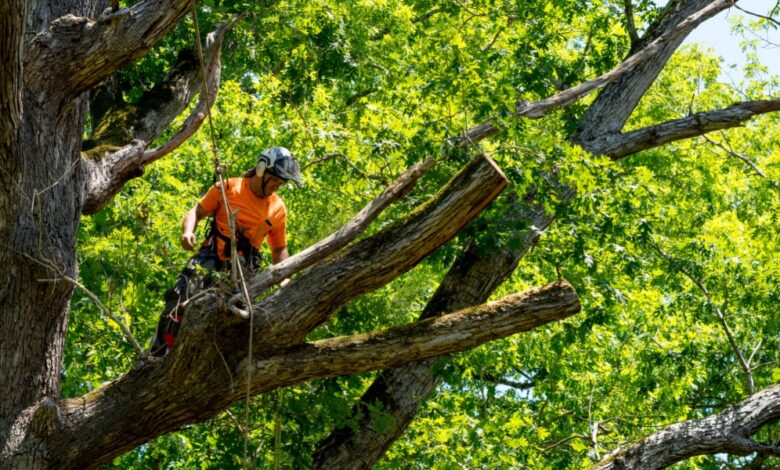
Tree climbing makes ordinary workplace safety rules feel considerably more important. A loose strap on the ground is annoying, but a loose strap 40 feet up is the beginning of a very different story.
For anyone entering professional tree care, what new arborists should know about climbing safety goes beyond learning knots and buying equipment. Safe climbing combines properly selected gear, careful inspection, good positioning, clear communication, and the judgment to recognize when conditions are less than ideal.
Treat the Harness Like Personal Protective Equipment
An arborist climbing harness serves a serious purpose—it supports the climber during positioning and movement while allowing enough mobility to work efficiently. Fit matters because arborists can spend extended periods suspended or partially supported by their climbing systems. A harness that pinches, shifts excessively, restricts movement, or does not provide appropriate adjustment creates problems as the workday progresses.
New climbers should pay attention to waist and leg adjustment, bridge configuration, attachment points, padding, and compatibility with the rest of their equipment. Understanding how to choose an arborist climbing harness puts these features into context rather than reducing the decision to price or appearance.
Most importantly, equipment should be used according to its manufacturer instructions and applicable workplace safety requirements. A climbing harness is not the place for improvisation.
Inspect Equipment Before Leaving the Ground
Arborist equipment lives a difficult life. Ropes encounter bark and debris. Hardware gets knocked around. Harnesses experience repeated loading, and connectors collect dirt, sap, and sawdust. That means a pre-climb inspection should become automatic.
Check ropes for glazing, cuts, unusual stiffness, contamination, excessive wear, or damaged splices and terminations. Examine harness webbing, stitching, buckles, attachment points, and the bridge for deterioration. Carabiners and other connectors should close, lock, and operate correctly.
The goal is not simply to spot equipment that has dramatically failed; small changes can indicate developing problems before they become obvious. Climbers should also know the retirement criteria for their specific equipment and replace items accordingly.
Understand the Entire Climbing System
A collection of individually excellent components does not automatically create an excellent climbing system. Ropes, friction devices, mechanical devices, connectors, harness attachment points, and other components must be suitable for their intended applications and compatible with one another. Manufacturer specifications matter here.
New arborists should receive hands-on instruction regarding whichever climbing systems they will actually use. That includes understanding how the system behaves while ascending, descending, positioning, and moving laterally through a canopy.
This is one area where technology has changed tree work significantly. Modern mechanical devices provide efficient movement and precise control, but sophisticated hardware still requires training.
Build Redundancy Into Critical Moments
Professional tree climbing requires climbers to think several moves ahead. Before changing position, transferring systems, or beginning a cut, consider what is supporting the climber and what would happen if something shifted unexpectedly.
That mindset becomes especially important when cutting aloft. Work positioning should help maintain stability and reduce the chance of contacting climbing components with cutting equipment.
The exact procedures depend on the task, equipment, climbing technique, and workplace requirements. New arborists should learn these procedures from qualified professionals rather than experimenting in the canopy.
Know That Positioning Is Part of Safety
Reaching a branch does not necessarily mean reaching a good working position. Poor positioning can leave a climber stretched, unstable, or relying excessively on physical strength. That increases fatigue and can make tool control more difficult.
Good positioning uses the climbing system and appropriate tie-in points to create a stable working stance. Whenever practical, the climber should be able to concentrate on the actual tree work instead of simultaneously performing a core workout to remain stable.
Tree structure also matters. Tie-in points must be evaluated for suitability, and arborists need to understand how factors such as decay, cracks, dead wood, weak unions, and species characteristics can affect structural integrity.
Keep Ground Crews in the Loop
Climbing safety is not solely the climber’s responsibility; tree work is a coordinated operation involving people above and below. Before work begins, crews should establish clear communication methods and responsibilities. Everyone needs to understand the work zone, equipment being used, expected sequence of operations, and procedures for controlling falling limbs or material.
Noise quickly complicates things. Chippers, saws, traffic, and hearing protection can make casual conversation nearly impossible, so teams may rely on standardized verbal commands, hand signals, or communication equipment to relay information.
Remember That Weather Changes the Equation
Trees do not provide controlled working environments. Wind can move limbs and climbing lines, and rain can affect footing and equipment handling. Heat can contribute to fatigue and dehydration, while cold conditions can reduce dexterity.
Conditions should be evaluated continuously rather than only when the crew arrives. A tree that seemed manageable in calm morning weather may present different risks after various conditions change. New arborists should develop the discipline to frequently reassess the working environment instead of treating the original plan as permanent.
Make Sure Rescue Planning Happens Before an Emergency
Aerial rescue is not something a crew wants to improvise while somebody is injured in a tree. Worksites should have appropriate emergency procedures in place, and personnel need training relevant to their roles. Crews should know how emergency services can access the site, how an injured climber could be reached, and what equipment may be required.
Training should also be refreshed periodically. Skills that exist only as a vague memory from a demonstration two years ago are not especially reassuring during a real emergency.
Keep in Mind That Experience Should Make Climbers More Careful
Perhaps the most important lesson in what new arborists should know about climbing safety is that confidence and competence are not the same thing. As climbing becomes familiar, it is easy for repetitive actions to feel harmless. That is exactly when inspections get rushed, shortcuts become tempting, and assumptions replace deliberate checks.
Experienced professionals can make complicated climbing look effortless because good technique becomes efficient. New arborists should aim for that efficiency without skipping the process required to develop it.
Climb deliberately, inspect equipment consistently, communicate clearly, and keep learning from qualified professionals. Trees are unpredictable enough already, so there is no reason to add avoidable surprises when working in tree care.