




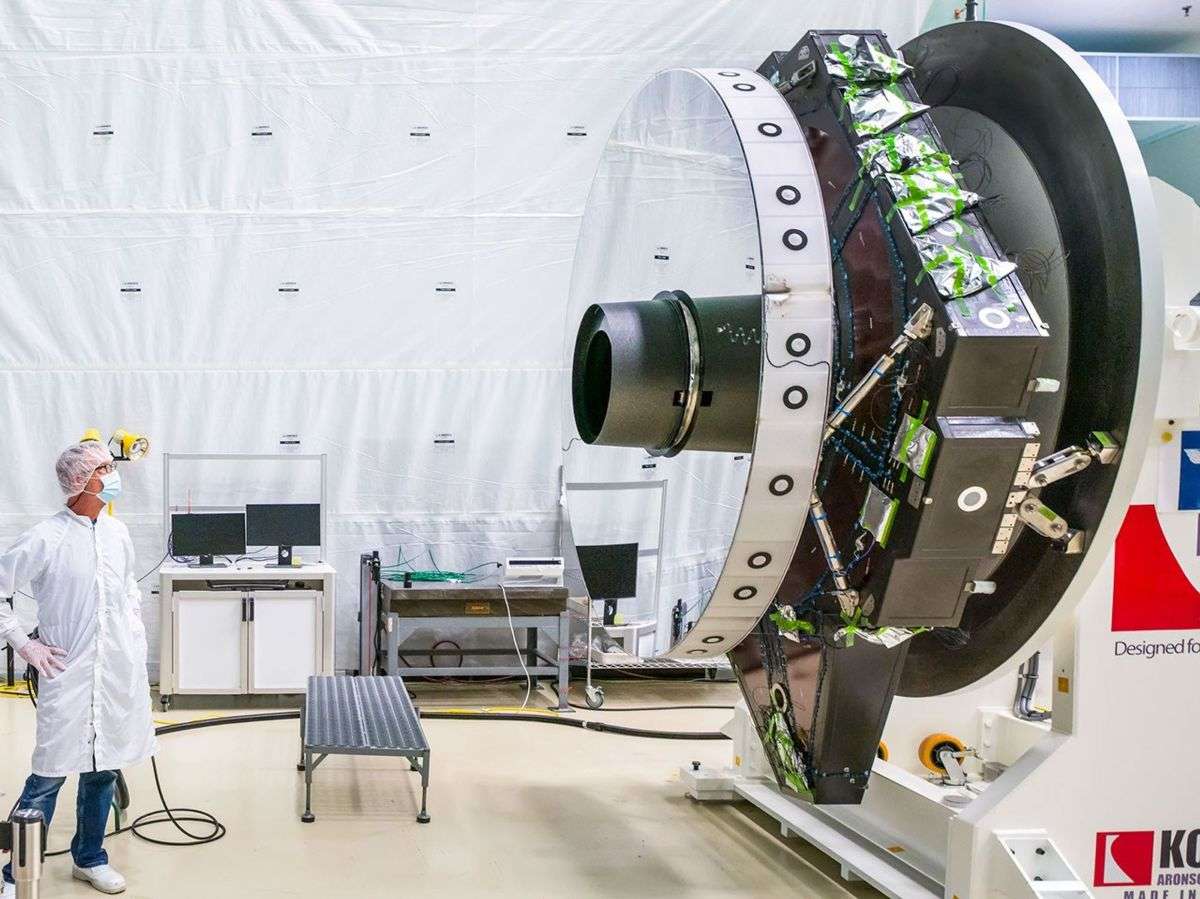
Technicians have completed the construction of NASA’s Nancy Grace Roman Space Telescope.
The Roman observatory is slated to launch no later than May 2027, with the team aiming for as early as fall 2026. The mission will revolutionize our understanding of the universe with its deep, crisp, sweeping views of space.
More than a thousand technicians and engineers assembled Roman from millions of individual components. Many parts were built and tested simultaneously to save time. Now that the observatory is assembled, it will undergo a spate of testing prior to shipping to NASA’s Kennedy Space Center in Florida in summer 2026.
NASA’s freshly assembled Nancy Grace Roman Space Telescope will revolutionize our understanding of the universe with its deep, crisp, sweeping infrared views of space. The mission will transform virtually every branch of astronomy and bring us closer to understanding the mysteries of dark energy, dark matter, and how common planets like Earth are throughout our galaxy. Roman is on track for launch by May 2027, with teams working toward a launch as early as fall 2026. Credit: NASA’s Goddard Space Flight Center
Telescope
The Optical Telescope Assembly is the heart of the Roman observatory. It consists of a primary mirror, which was designed and built at L3Harris Technologies in Rochester, New York, plus nine additional mirrors and supporting structures and electronics.
The Roman team got a jumpstart by receiving the telescope’s primary mirror, which will collect and focus light from cosmic objects near and far, from another government agency and then modifying it to meet NASA’s needs. Using this mirror, Roman will capture stunning space vistas with a field of view at least 100 times larger than Hubble’s.
Roman will peer through dust and across vast stretches of space and time to study the universe using infrared light, which human eyes can’t see. The amount of detail these observations will reveal is directly related to the size of the telescope’s mirror, since a larger surface gathers more light and measures finer features. Roman’s primary mirror is 7.9 feet (2.4 meters) across, the same size as the Hubble Space Telescope’s main mirror but less than one-fourth the weight (410 pounds, or 186 kilograms) thanks to major improvements in technology.
“The telescope will be the foundation of all of the science Roman will do, so its design and performance are among the largest factors in the mission’s survey capability.”

Josh Abel
lead Optical Telescope Assembly systems engineer at NASA Goddard
About The Author


Got a Questions?
Find us on Socials or Contact us and we’ll get back to you as soon as possible.