




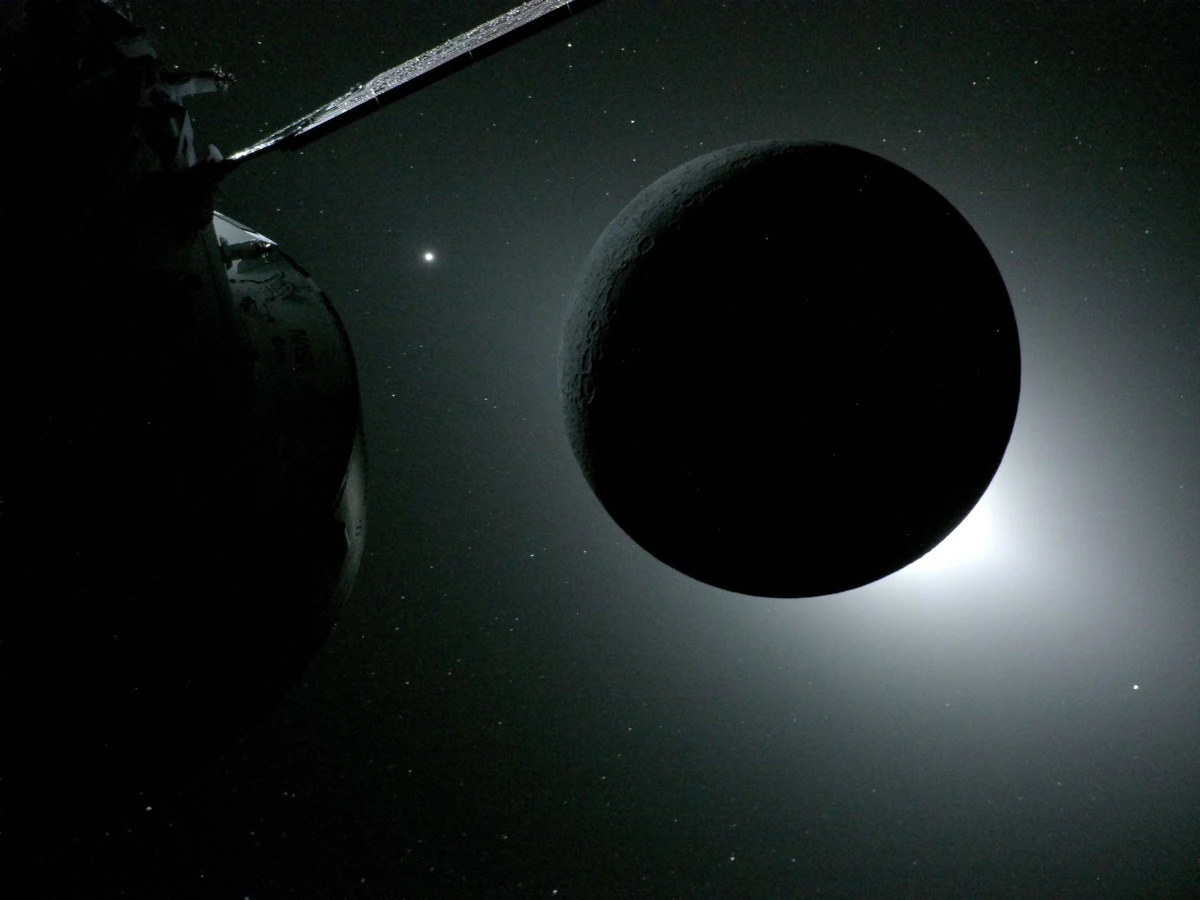
Millions of people watched the historic launch of Artemis II and were captivated by the mission’s 10-day journey around the Moon as NASA astronauts Reid Wiseman, Victor Glover, and Christina Koch, and CSA (Canadian Space Agency) astronaut Jeremy Hansen ventured farther into space than any human before. Part of the public’s ability to experience the mission in high-definition was due to laser communications.
Play Video
An animation depicting the Orion capsule using infrared light. Although infrared light is shown here, it is actually invisible to the human eye.
NASA/Dave Ryan
Laser, or optical, communications systems use invisible infrared light to transmit more data in a single downlink than traditional radio frequency systems. During Artemis II, NASA tested an optical communications system to demonstrate the benefits laser communications can bring to future human spaceflight missions to the Moon.
The optical terminal, a payload attached to the Orion spacecraft’s exterior, marked the first time laser communications supported a crewed mission at lunar distance. The terminal collected and transmitted high-definition video, flight procedures, photos, engineering and science data, and voice communications to Earth over laser signals when the spacecraft had line of sight with ground terminals.
About The Author


Got a Questions?
Find us on Socials or Contact us and we’ll get back to you as soon as possible.