Downloads
NASA’s Juno Peers Beneath Io’s Surface
PNG (2.07 MB)
Description
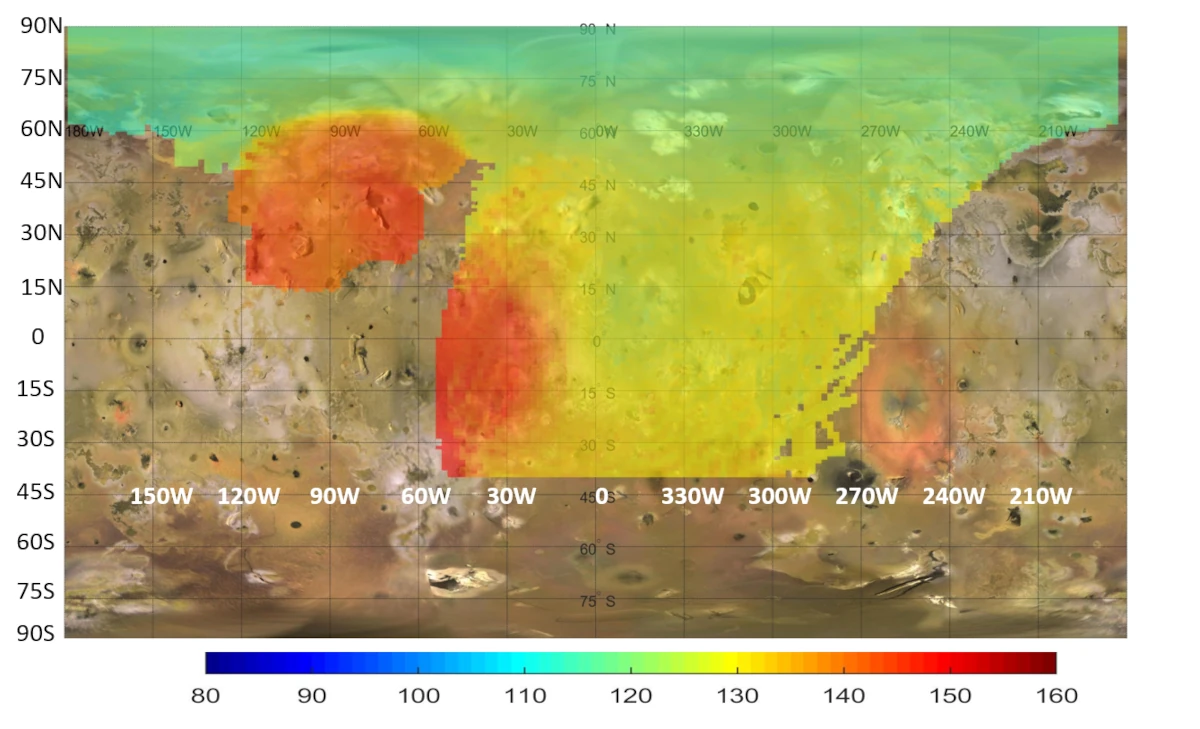
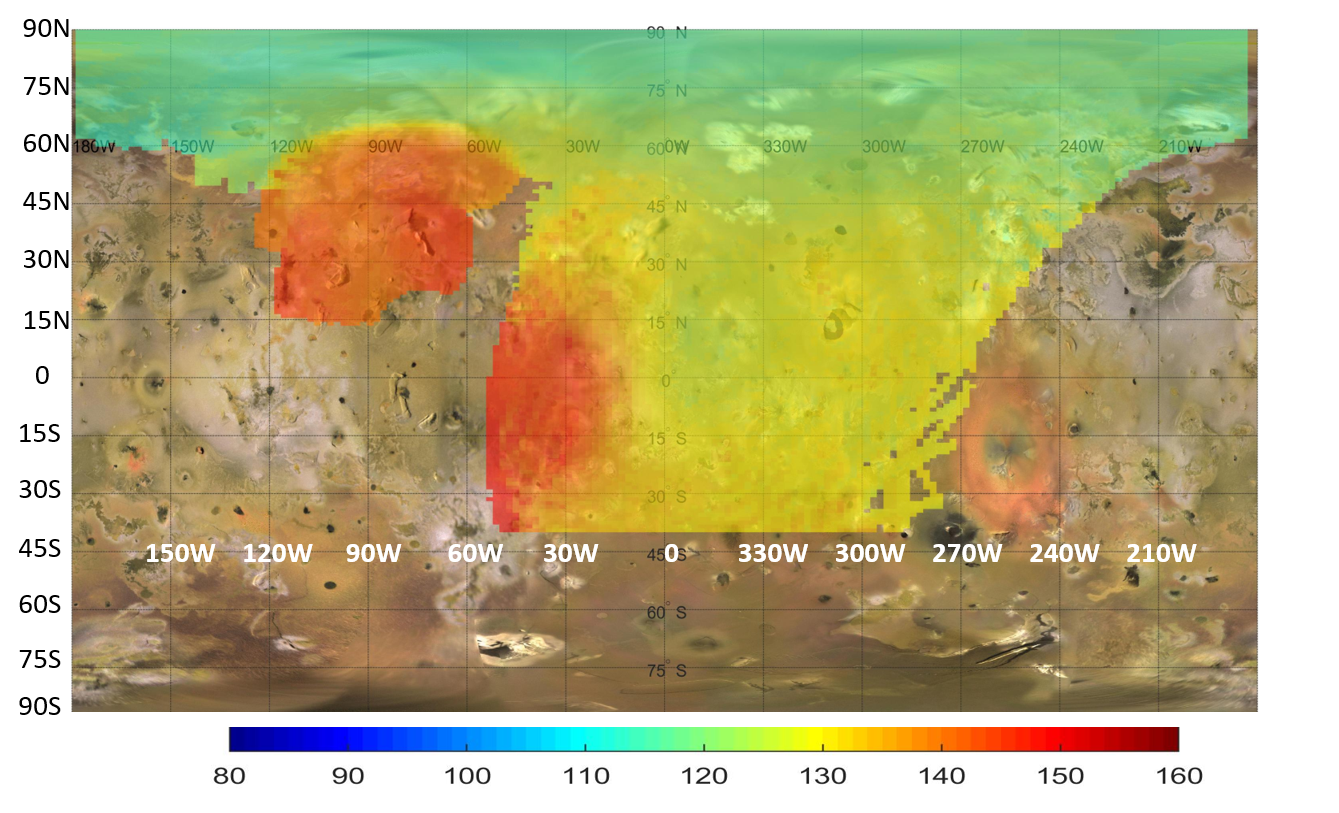
This map represents data captured by the Microwave Radiometer (MWR) aboard NASA’s Juno spacecraft, indicating heat rising from just beneath the surface of Jupiter’s moon Io. While infrared instruments measure the temperature of the moon’s surface, the lowest frequency microwave channels (0.6 and 1.25 gigahertz) on the MWR can penetrate between about 6 and 20 feet (2 and 6 meters) into the crust. The colors on this map illustrate a distinct temperature gradient across the moon, with the most extreme, localized heat output in red.
The most prominent red anomaly in the upper left (between 60 and 120 degrees west longitude) reveals subsurface temperatures 18 to 36 degrees Fahrenheit (10 to 20 degrees Celsius, or 10 to 20 Kelvin) warmer than the surrounding area. This massive regional heat source coincides with the Zal Montes Patera complex, an area where Juno’s Stellar Reference Unit observed an active lava flow. A second major subsurface heat source is also visible near the equator, stretching from 0 to 50 degrees west longitude. Together, these distinct microwave anomalies indicate significant internal heating occurring within the upper tens of meters of Io’s crust.
Contrasting with these intense hot spots are the yellow and green regions, which reflect temperatures more common across the moon. The yellow areas represent intermediate temperatures that naturally warm up to near -190°F (-123°C, or 150 Kelvin) as they approach the equator. Meanwhile, the green areas, primarily visible toward the higher northern latitudes, indicate the coolest subsurface temperatures, dropping to around -298°F (-183°C, or 90 Kelvin) near the pole.
NASA’s Jet Propulsion Laboratory, a division of Caltech in Pasadena, California, manages the Juno mission for the principal investigator, Scott Bolton, of the Southwest Research Institute in San Antonio. Juno is part of NASA’s New Frontiers Program, which is managed at NASA’s Marshall Space Flight Center in Huntsville, Alabama, for the agency’s Science Mission Directorate in Washington. The MWR was built by JPL. Lockheed Martin Space in Denver built and operates the spacecraft.
More information about Juno is at: http://www.nasa.gov/juno