
NASA
-
NASA Aircraft Coordinate Science Flights to Measure Air Quality
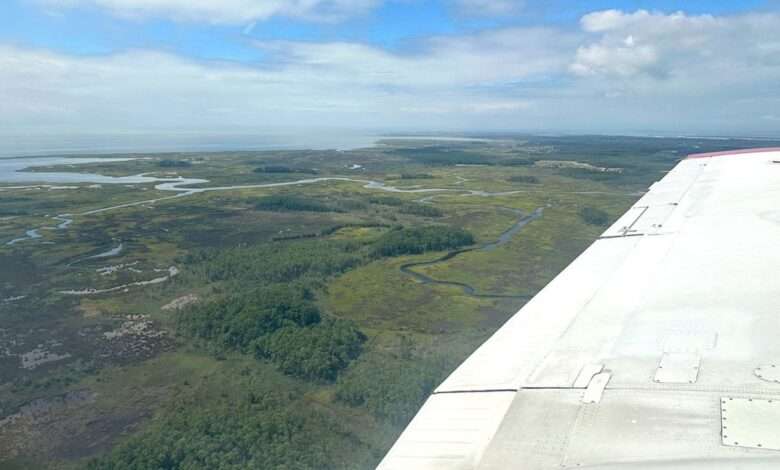
Magic is in the air. No wait… MAGEQ is in the air, featuring scientists from NASA centers across the country who teamed up with the National Oceanic and Atmospheric Administration (NOAA), the University of Maryland Baltimore County, and several other university and government partners and collaborators. This summer, six planes collectively flew more than 400 hours over the mid-Atlantic United…
Read More » -
NASA Data Powers New Tool to Protect Water Supply After Fires
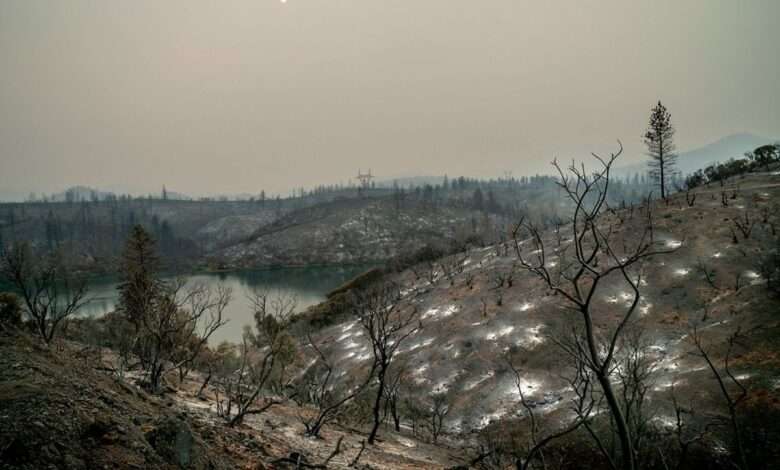
When wildfires scorch a landscape, the flames are just the beginning. NASA is helping communities across the nation foresee and prepare for what can follow: mudslides, flash flooding, and contaminated surface water supplies. A new online tool called HydroFlame, built with support from NASA’s Earth Science Division, relies on satellite data, hydrologic modeling, and artificial intelligence to predict how wildfires could…
Read More » -

Airplane Aerobatics
NASA astronaut Nick Hague watches as Robert Schmidle Pitts Aerobatics perform, Friday, Sept. 12, 2025, at Joint Base Andrews in Prince George’s County, Maryland. Hague spent 171 days aboard the International Space Station as part of Expedition 72. While aboard the orbital laboratory, Hague and fellow NASA astronauts Suni Williams and Butch Wilmore completed more than 900 hours of research between more than 150…
Read More » -
Help Map the Moon’s Molten Flows!
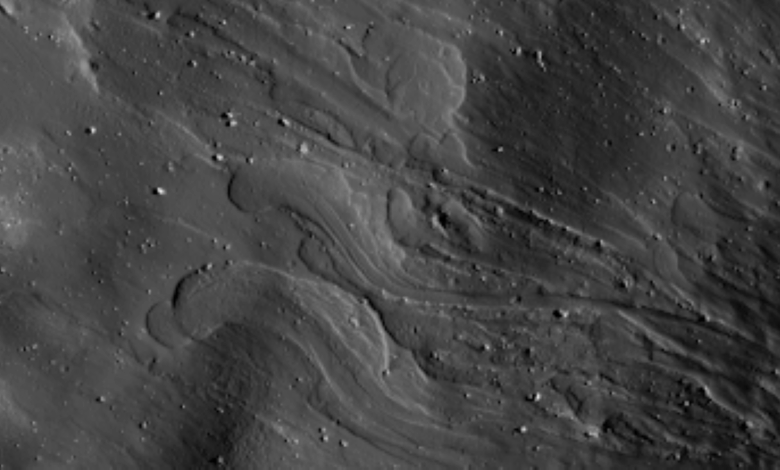
When asteroids hit the Moon, the impacts carve out craters and with enough energy and pressure, melt parts of the rocky surface. Often, the white hot, gooey melt (it’s like lava, except that it doesn’t erupt from underground) sloshes around the new crater and surrounding regions. The molten rock cools and hardens into vast rock features called impact melt flow deposits. These…
Read More » -

NASA’s Webb Explores Largest Star-Forming Cloud in Milky Way
NASA’s James Webb Space Telescope has revealed a colorful array of massive stars and glowing cosmic dust in the Sagittarius B2 molecular cloud, the most massive and active star-forming region in our Milky Way galaxy. “Webb’s powerful infrared instruments provide detail we’ve never been able to see before, which will help us to understand some of the still-elusive mysteries of…
Read More » -

NASA, NOAA Launch Three Spacecraft to Map Sun’s Influence Across Space
Lee este comunicado de prensa en español aquí. NASA and the National Oceanic and Atmospheric Administration (NOAA) launched three new missions Wednesday to investigate the Sun’s influence across the solar system. At 7:30 a.m. EDT, a SpaceX Falcon 9 rocket lifted off from Launch Complex 39A at NASA’s Kennedy Space Center in Florida carrying the agency’s IMAP (Interstellar Mapping and Acceleration…
Read More » -
NASA Launches 2026 Gateways to Blue Skies Competition
NASA’s 2026 Gateways to Blue Skies competition invites collegiate teams to conceptualize innovative systems and practices that would advance current commercial aircraft maintenance, repair, and operations with the goal to enhance resilience, safety, and efficiency. The commercial aviation industry is a crucial component of the U.S. economy, employing millions and supporting global commerce and tourism. However, the industry faces certain challenges,…
Read More » -

Curiosity Blog, Sols 4661-4667: Peaking Into the Hollows
By Susanne P. Schwenzer, Professor of Planetary Mineralogy at The Open University, UK Earth planning date: Friday, Sept. 19, 2025 Curiosity is currently driving along the ridges of a very uneven terrain. One of the bigger ridges we nicknamed “Autobahn,” which is the German word for a highway. But the rover didn’t stay on that autobahn, now more officially named…
Read More » -
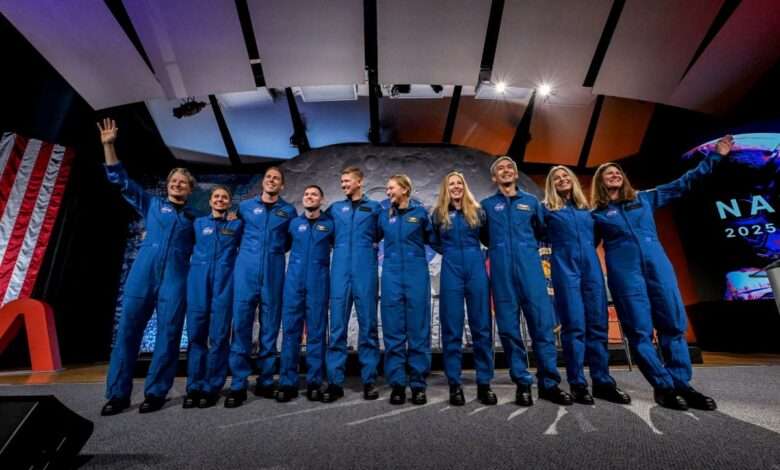
NASA’s New Astronaut Candidates
NASA’s 2025 astronaut candidate class greets the crowd in this Sept. 22, 2025, image. The group was introduced Monday following a competitive selection process of more than 8,000 applicants from across the United States. The class now will complete nearly two years of training before becoming eligible for flight assignments supporting future science and exploration missions to low Earth orbit, the Moon,…
Read More » -

The Need to Bake Out Silicone Based Thermal Control Coatings
BackgroundThe NASA Engineering and Safety Center (NESC) has reviewed flight, ground test, and published data on ultraviolet-induced degradation of silicone based thermal control coatings. Analysis has shown, for at least one silicone coating, that bake-out plays an important role in ultraviolet (UV) degradation, indicating that UV interaction with paint volatiles, and not the structural material, is the primary source of…
Read More »