
NASA
-

Efficient Large Displacement/Large Rotation Dynamic Simulations Using Nonlinear Dynamic Substructures
Download PDF: Efficient Large Displacement/Large Rotation Dynamic Simulations Using Nonlinear Dynamic Substructures Utilizing reduced-order dynamic math models (DMM) in linear system-level dynamic analyses is a well-known practice that enables extreme computational efficiencies. But what about nonlinear system dynamics? Reduced-order DMMs have found their way into contact dynamics. The engineer must look no further than the Henkel-Mar pad separation analysis methodology…
Read More » -

Dust Outbreak Reaches Europe
Winter winds lofted clouds of dust from the Sahara Desert, carrying it north toward the Mediterranean and dispersing it widely across Europe in March 2026. When the dust combined with moisture-laden weather systems, a dirty rain fell in parts of Spain, France, and the United Kingdom. This animation highlights the concentration and movement of dust throughout the region from March…
Read More » -

2026 William T. Pecora Award Nominations Now Being Accepted
By USGS Landsat Missions The William T. Pecora Award is presented annually to individuals or teams using satellite or aerial remote sensing that make outstanding contributions toward understanding the Earth (land, oceans, and air), educating the next generation of scientists, informing decision-makers, or supporting natural or human-induced disaster response. Both national and international nominations are welcome. The award is sponsored jointly…
Read More » -

Telescopes Team Up for New View of Cat’s Eye Nebula
This March 3, 2026, image combines views from ESA’s (European Space Agency) Euclid and NASA’s Hubble Space Telescope to feature one of the most visually intricate remnants of a dying star: the Cat’s Eye Nebula, also known as NGC 6543. This extraordinary planetary nebula lies 4,400 light-years away in the constellation Draco and has captivated astronomers for decades with its elaborate and multilayered structure. See…
Read More » -
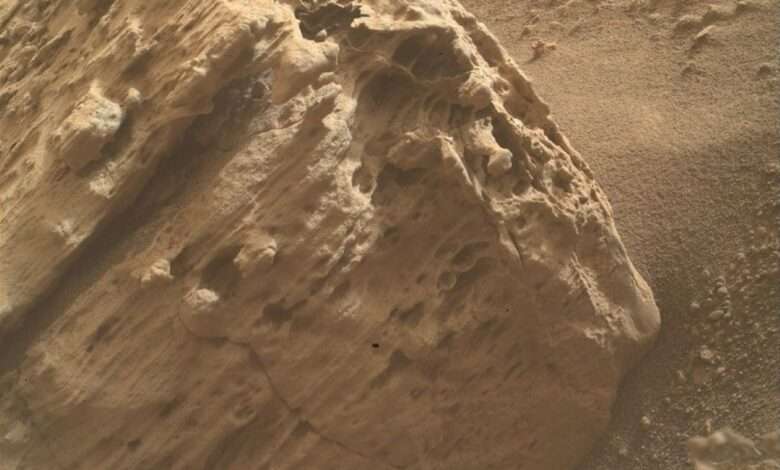
Curiosity Blog, Sols 4825-4831: Exploring the Borderlands
Written by William Farrand, Senior Research Scientist, Space Science Institute Earth planning date: Friday, March 6, 2026 Curiosity is in the last stage of its exploration of the spiderweb-like boxwork unit. This stage consists of exploring the eastern and southern borders of this terrain. There were two multi-sol plans assembled this week. The previous plan put Curiosity at a site…
Read More » -
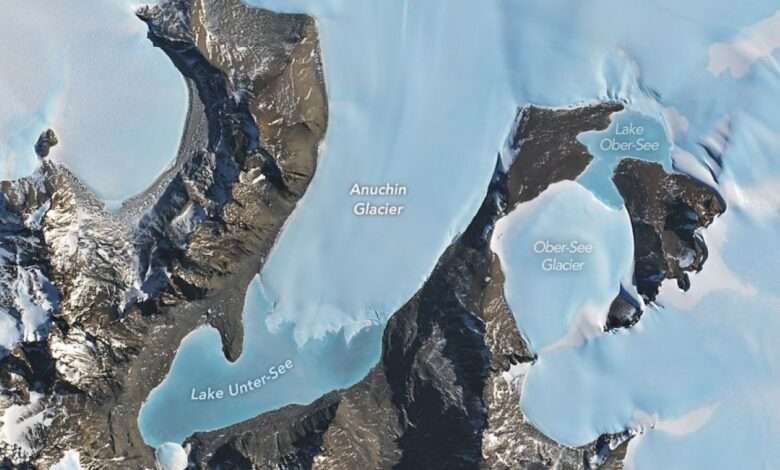
A Most Unusual Lake
Scientists estimate that Earth is home to more than 100 million lakes. Among the most unusual is Lake Unter-See, one of Antarctica’s largest and deepest surface lakes, known for its distinctive water chemistry. Its ice-covered waters have exceptionally high levels of dissolved oxygen, low dissolved carbon dioxide, and a strongly alkaline (basic) pH. The OLI (Operational Land Imager) on Landsat 9 captured this image on February…
Read More » -
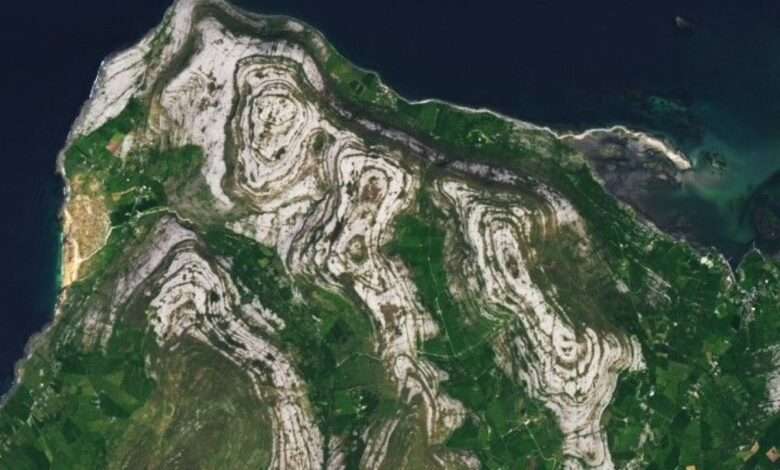
March 2026 Satellite Puzzler
Every month, NASA Earth Observatory features a puzzling satellite image. The March 2026 puzzler appears above. Your ChallengeIdentify the location shown in this satellite image. Share what clues you see, where you think it is, and what makes this place interesting or unique to you. How to AnswerSubmit your response using this form and select “Puzzler Answer” as the topic. Please include your preferred…
Read More » -

About Subsonic Vehicle Technologies and Tools Project
Project Overview NASA’s Subsonic Vehicle Technologies and Tools (SVTT) project develops technologies and tools for various types of aircraft that fly in different speed regimes, including next-generation vertical take-off and landing and fixed-wing subsonic aircraft. The research advances knowledge, technologies, and concepts that enable major steps to lowering operating costs of the next-generation single-aisle aircraft. SVTT also develops computer modeling…
Read More » -
Insights into Spallation Mechanisms of Thermal Protection System Materials from Mass Spectrometry and HyMETS Testing
Download PDF: Insights into Spallation Mechanisms of Thermal Protection System Materials from Mass Spectrometry and HyMETS Testing An effort was undertaken to investigate the mechanisms responsible for internal pressure build up within thermal protection system (TPS) materials subjected to high-enthalpy environments. Understanding how gases evolve, migrate, and interact with the microstructure of a TPS is essential for predicting degradation and failure modes…
Read More » -

Computational Modeling of Failure at the Fabric Weave Level in Reentry Parachute Energy Modulators
Download PDF: Computational Modeling of Failure at the Fabric Weave Level in Reentry Parachute Energy Modulators Energy modulators (EM) are textile mechanical devices designed to dissipate snatch loads that occur when parachutes are deployed. Although critical for mitigating shock loads, recent flight testing has shown increasing variability in EM behavior, raising concerns about their performance predictability and potential failure under dynamic loading…
Read More »