




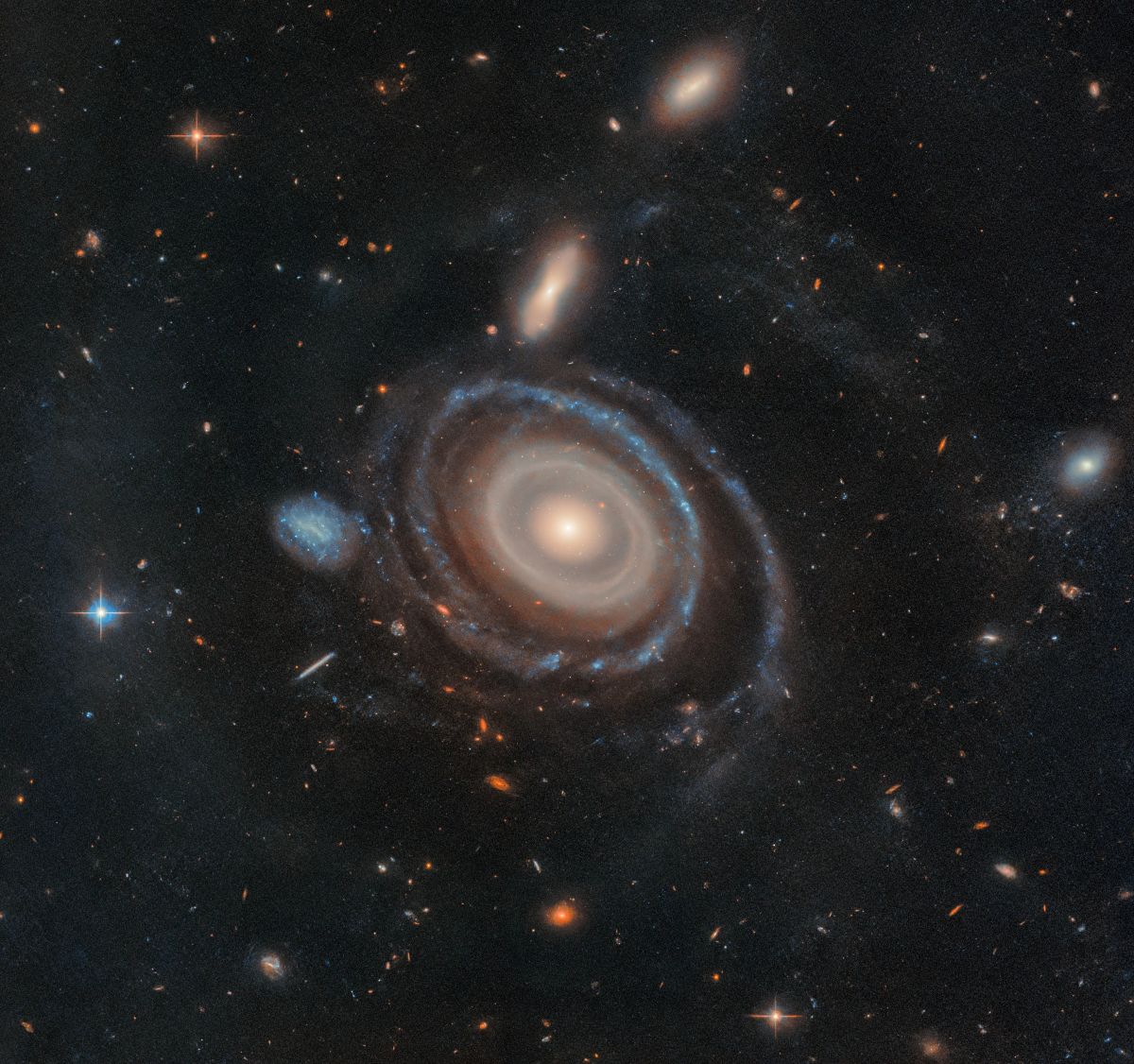
This image from NASA’s Hubble Space Telescope, released on Feb. 4, 2025, shows the gargantuan galaxy LEDA 1313424, aptly nicknamed the Bullseye. A far smaller blue dwarf galaxy went through the Bullseye’s center, leaving nine star-filled rings. Astronomers using Hubble identified eight visible rings, more than previously detected by any telescope in any galaxy, and confirmed a ninth using data from the W. M. Keck Observatory in Hawaii. Previous observations of other galaxies show a maximum of two or three rings.
Hubble and Keck’s follow-up observations also helped the researchers prove which galaxy plunged through the center of the Bullseye — a blue dwarf galaxy to its center-left. This relatively tiny interloper traveled like a dart through the core of the Bullseye about 50 million years ago, leaving rings in its wake like ripples in a pond. A thin trail of gas now links the pair, though they are currently separated by 130,000 light-years.
Read more about this “serendipitous discovery.”
Image credit: NASA, ESA, Imad Pasha (Yale), Pieter van Dokkum (Yale)
About The Author


Got a Questions?
Find us on Socials or Contact us and we’ll get back to you as soon as possible.