from NASA’s Heliophysics Education Activation Team (NASA HEAT) and the Astronomical Society of the Pacific/Night Sky Network
Have you ever wondered about what the Sun is made of? Or why do you get sunburned on even cloudy days? NASA’s new Explore the Sun toolkit brings the wonders of solar science to you, offering answers to these questions and more!
.jpg?w=5438&h=3638&fit=clip&crop=faces%2Cfocalpoint)
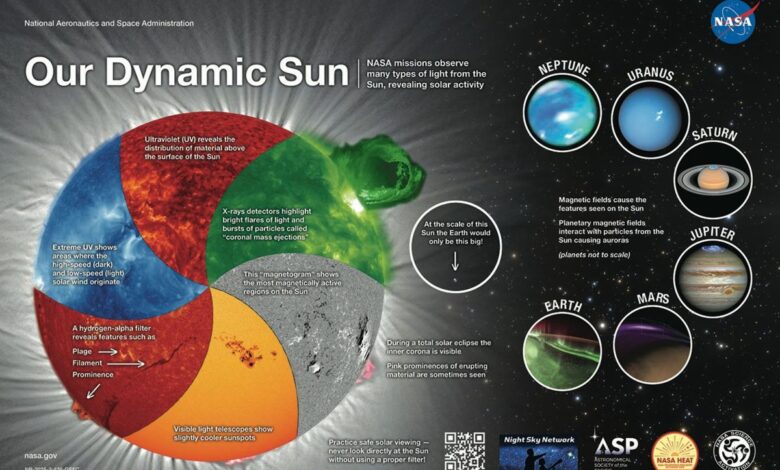
Solar images from NASA’s Solar Dynamics Observatory show different features on the Sun, including sunspots in the visible light spectrum. Filaments and prominences can be seen in hydrogen-alpha, coronal mass ejections in X-ray, and details in ultraviolet light. On the right side of the banner, aurorae observed on Earth by the International Space Station is shown, along with aurorae on other planets as seen by NASA’s Hubble Space Telescope and James Webb Space Telescope.
NASA/Astronomical Society of the Pacific
A collaboration between NASA’s Heliophysics Education Activation Team (NASA HEAT) and the Astronomical Society of the Pacific’s Night Sky Network program, this resource was developed for informal educators, amateur astronomers, and astronomy enthusiasts alike, providing engaging activities for anyone eager to learn more about our nearest star.
Whether you’re hosting a solar viewing event or an indoor presentation, the Our Dynamic Sun toolkit provides easy-to-use materials designed to spark curiosity. Each card in the set pairs NASA images with clear explanations for each topic:
- “What color is the Sun?” (hint: it’s not yellow!)
- “How does the Sun affect us here on Earth?”
- “When will the Sun die?”
These cards not only answer common questions the public may have, but also highlight how NASA’s solar research helps us understand space weather, solar storms, and their impacts on our daily lives.
Bring the Sun’s story to your community and inspire the next generation of explorers. You can download this free Our Dynamic Sun toolkit here: https://bit.ly/suntoolkit
About The Author