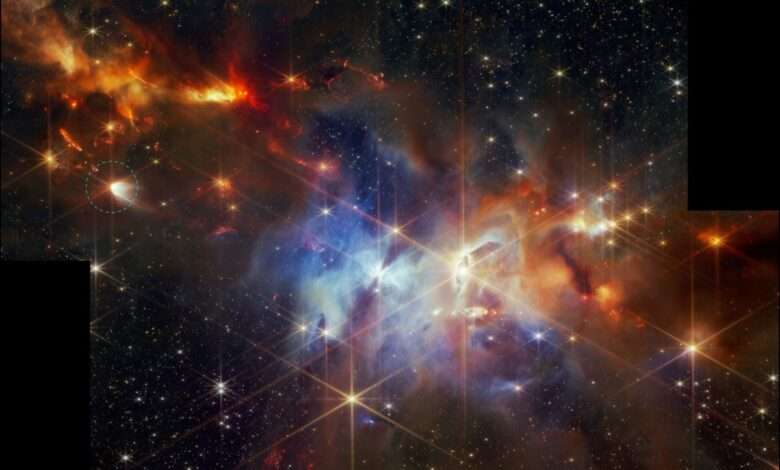
The NIRCam (Near-Infrared Camera) on NASA’s James Webb Space Telescope captured the actively forming protostar EC 53 (circled at left) in the Serpens Nebula in this image released on Jan. 21, 2026.
Astronomers have long sought evidence to explain why comets at the outskirts of our own solar system contain crystalline silicates, since crystals require intense heat to form and these “dirty snowballs” spend most of their time in the ultracold Kuiper Belt and Oort Cloud. Now, looking outside our solar system, Webb has returned the first conclusive evidence that links how those conditions are possible.
The telescope clearly showed for the first time that the hot, inner part of the disk of gas and dust surrounding a very young, actively forming star is where crystalline silicates are forged. Webb also revealed a strong outflow that is capable of carrying the crystals to the outer edges of this disk. Compared to our own fully formed, mostly dust-cleared solar system, the crystals would be forming approximately between the Sun and Earth.
Read more about this discovery.
Image credit: NASA, ESA, CSA, STScI, Klaus Pontoppidan (NASA-JPL), Joel Green (STScI); Image Processing: Alyssa Pagan (STScI)
About The Author