Press Releases
Astrobotic Showcases Griffin-1 Lunar Lander Ahead of Environmental Testing

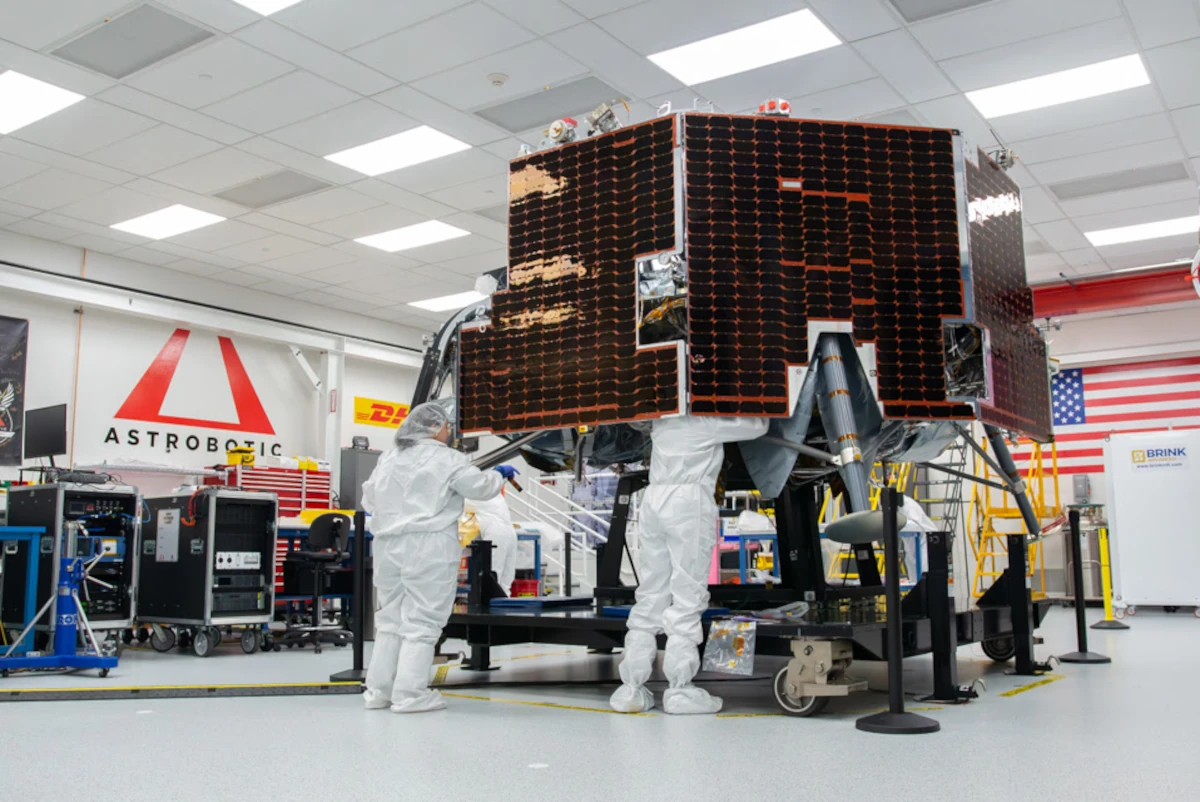
| Astrobotic today unveiled its Griffin Mission One (Griffin-1) lunar lander, recently designated by NASA as Moon Base II, during a visit by NASA representatives, government officials, and industry partners at the company’s headquarters in Pittsburgh. The spacecraft is completing final integration activities and is scheduled to launch in late 2026.Griffin-1 is being developed as part of the Commercial Lunar Payload Services (CLPS) initiative in support of NASA’s Moon Base. The mission will deliver the largest commercial payload ever sent to the Moon and demonstrate Griffin as an infrastructure-class lander capable of delivering Moon Base cargo such as rovers, science instruments, and solar-based power plants.Featured speakers at the event included leaders from across the commercial space industry, government, and education sectors, including:• Carlos García-Galán, Program Executive for the Moon Base, NASA• Ryan Stephan, Acting Director for Cargo Landers, NASA • John Thornton, Chief Executive Officer, Astrobotic• Matt Magaña, President, Defense & National Security, Voyager• Kelly Randell, Business Development Manager, Astrolab • Justine Kasznica, Founding Board Chair, Keystone Space Collaborative • Dr. Jimyse Brown, Executive Director, Moonshot Museum The lander was displayed inside Astrobotic’s clean room within the spacecraft integration facility, where engineers are completing final assembly ahead of an extensive environmental test campaign. |
 |
Image: Carlos García-Galán, Program Executive for the Moon Base, NASA, delivers remarks with Astrobotic’s Griffin-1 (Moon Base II) lunar lander behind him. |
“When Astrobotic was founded nearly two decades ago, the idea that a team in Pittsburgh could build and fly one of the world’s largest commercial lunar landers felt incredibly ambitious,” said John Thornton, CEO of Astrobotic. “Today, Griffin stands behind us as proof of what is possible when talented people spend years solving hard problems together. This spacecraft represents the transportation and logistics systems that will enable humanity’s long-term future beyond Earth. Seeing Griffin ready for its next phase of testing is a proud moment for our team and an important milestone for NASA’s Moon Base.” |
 |
Image: John Thornton, Astrobotic’s CEO, delivers remarks with Astrobotic’s Griffin-1 (Moon Base II) lunar lander behind him. |
Several mission payloads have already been integrated onto Griffin-1, including BEACON, a CubeRover-based joint mission with Mission Control Space Services, and LandCam-X, a payload from the European Space Agency that will improve landing precision and safety. The mission’s largest payload, Astrolab’s FLIP rover, will be integrated at launch processing facilities in Florida prior to liftoff. Through Moon Base II, FLIP will help demonstrate the mobility, logistics, and autonomous surface operations capabilities NASA has identified as foundational for future lunar terrain vehicles and sustained lunar exploration. “Landing on the Moon is only the first step,” said Jaret Matthews, founder and CEO of Astrolab. “Building a sustained presence requires the ability to move cargo, instruments, resources, and future astronauts across the lunar surface. FLIP will help demonstrate the mobility and autonomous operations capabilities NASA has identified as essential for the future Moon Base, while providing valuable experience for the next generation of lunar vehicles.” |
 |
| Image: Matt Magaña, John Thornton, Carlos García-Galán, Kelly Randell, Justine Kasznica, Ryan Stephan, and Dr.Jimyse Brown gather for a photo op in front of Griffin-1 (Moon Base II). |
Following integration at Astrobotic headquarters, Griffin-1 will be transported to California for environmental testing next week. During the campaign, the integrated spacecraft will undergo a series of industry-standard qualification and acceptance tests designed to verify its ability to withstand launch, spaceflight, and lunar mission environments. The environmental test program builds on years of component- and subsystem-level testing, analysis, simulation, and prototype development conducted throughout the spacecraft’s design and manufacturing process. “Seeing Griffin fully integrated in our cleanroom is a major milestone for the mission and for the hundreds of engineers, technicians, and partners who have contributed to its development,” said Nick Newell, Director of Space Programs at Astrobotic. “The spacecraft we’re preparing to test is the culmination of years of design, manufacturing, assembly, and verification work. As Griffin moves into environmental testing, we’ll be validating that the integrated vehicle can withstand the demands of launch and its journey to the Moon. Each milestone brings us one step closer to making the Moon Base a reality.” “Seeing Griffin standing fully integrated is a genuinely exciting moment for Astrobotic and a powerful reminder of how far the team has come,” said Matt Magaña, president, Space, Defense & National Security, Voyager Technologies. “Combined with Voyager’s broader capabilities, it marks another important step toward realizing our shared vision for a sustained human presence on the Moon and beyond.” Later this year, Griffin-1 will be delivered to Cape Canaveral, Florida, for final launch preparations. Following integration of Astrolab’s FLIP rover, the spacecraft is scheduled to launch in late 2026. After separation from the launch vehicle, Griffin-1 will be operated from Astrobotic’s Mission Control Center in Pittsburgh, where mission controllers will oversee the spacecraft’s transit to the Moon, landing operations, and surface payload operations following touchdown. |
| About Astrobotic Astrobotic is America’s commercial lunar logistics and robotics company. Founded in 2007, Astrobotic has secured more than $600 million in NASA and DoD contracts, launched America’s first commercial lunar lander into space, and develops landers, rovers, lunar power infrastructure, and reusable rockets from its Moon Base headquarters in Pittsburgh, Pennsylvania. Visit astrobotic.com. |