




by Kat Troche of the Astronomical Society of the Pacific
September brings the gas giants Jupiter and Saturn back into view, along with their satellites. And while we organize celebrations to observe our own Moon this month, be sure to grab a telescope or binoculars to see other moons within our Solar System! We recommend observing these moons (and planets!) when they are at their highest in the night sky, to get the best possible unobstructed views.
The More the Merrier
As of September 2024, the ringed planet Saturn has 146 identified moons in its orbit. These celestial bodies range in size; the smallest being a few hundred feet across, to Titan, the second largest moon in our solar system.
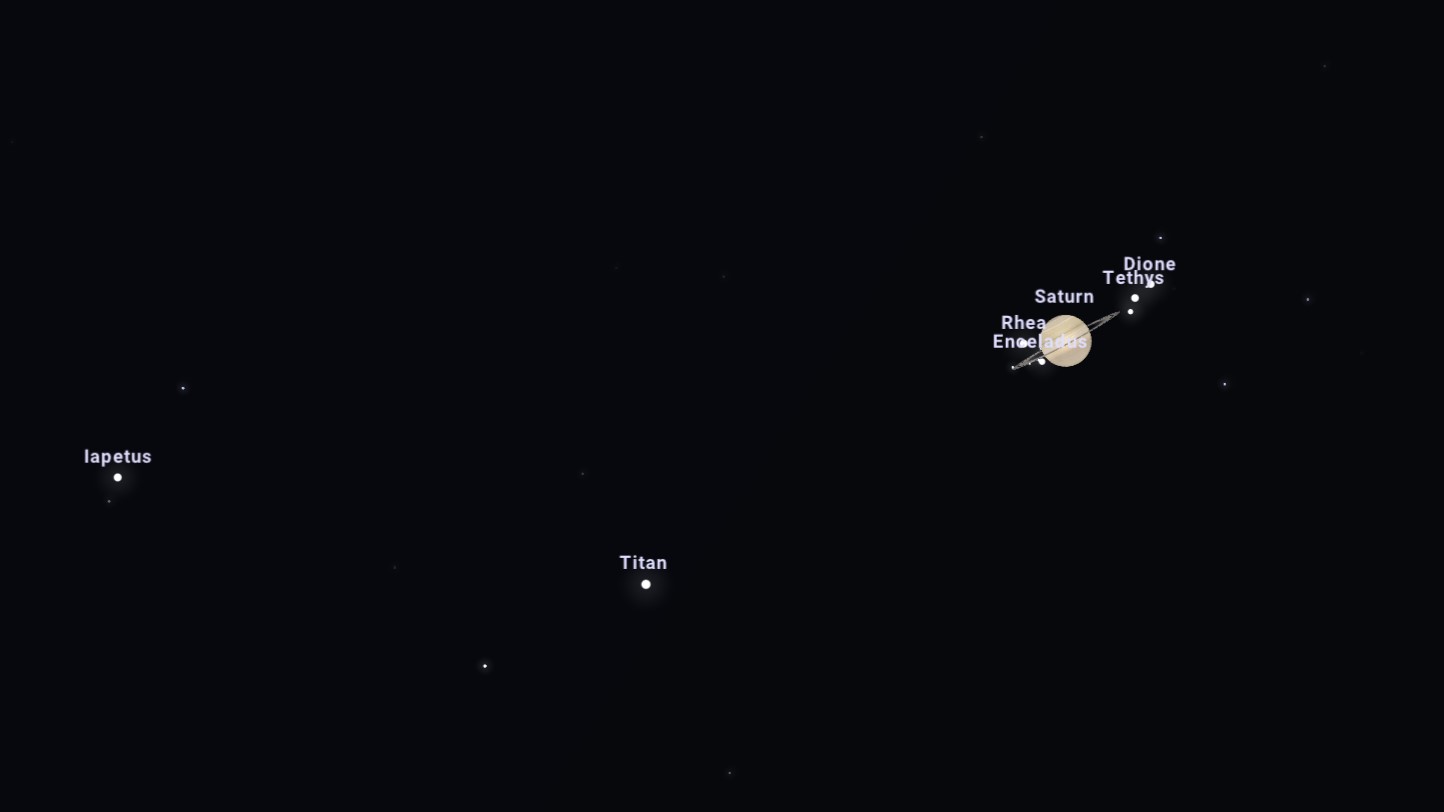
The Saturnian system along with various moons around the planet Saturn: Iapetus, Titan, Enceladus, Rhea, Tethys, and Dione.
Stellarium Web
Even at nearly 900 million miles away, Titan can be easily spotted next to Saturn with a 4-inch telescope, under urban and suburban skies, due to its sheer size. With an atmosphere of mostly nitrogen with traces of hydrogen and methane, Titan was briefly explored in 2005 with the Huygens probe as part of the Cassini-Huygens mission, providing more information about the surface of Titan. NASA’s mission Dragonfly is set to explore the surface of Titan in the 2030s.
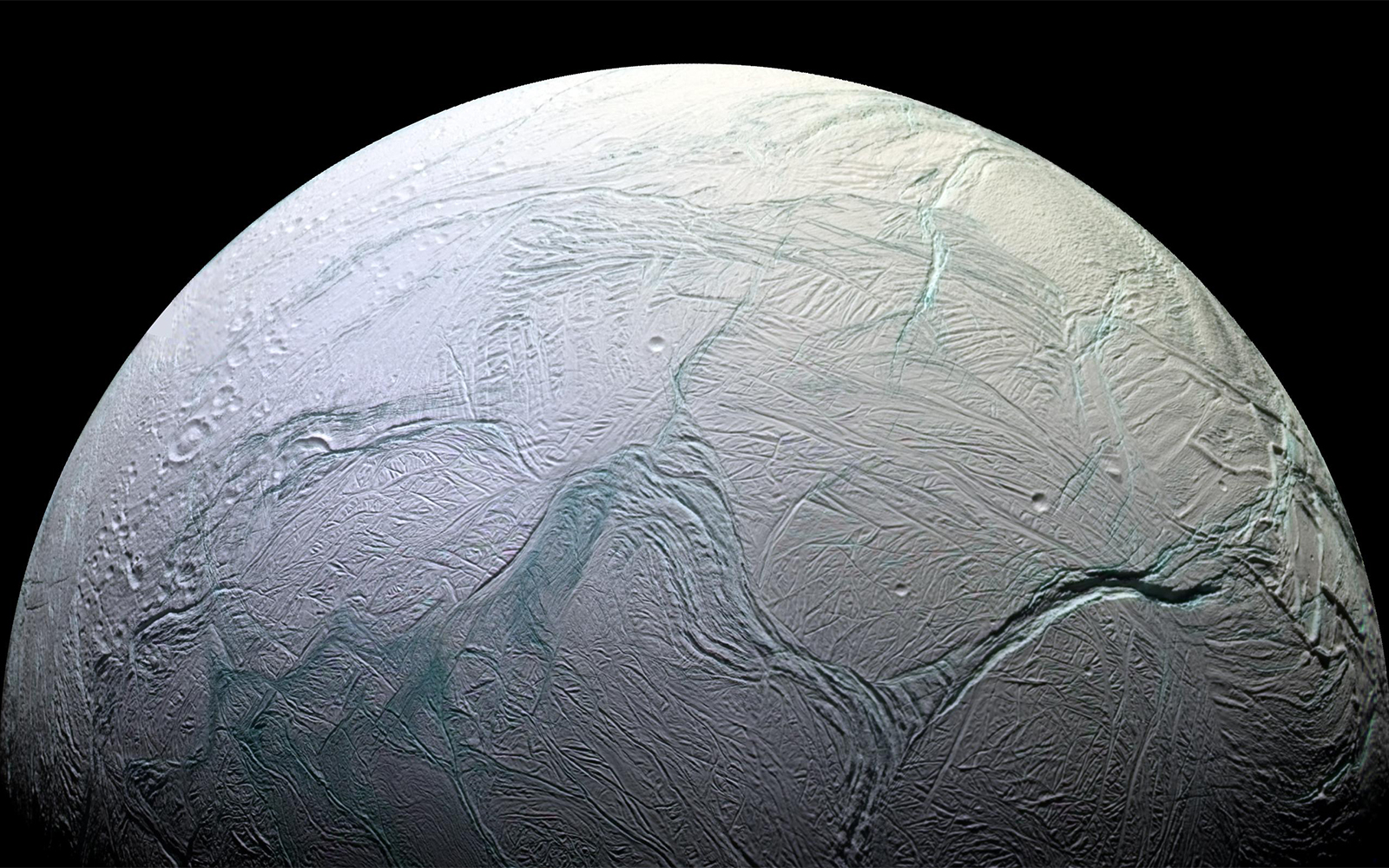
Enceladus is an icy world much like Hoth, except that it has an ocean under its frozen crust. Astronomers believe this moon of Saturn may be a good candidate for having extraterrestrial life beneath its surface.
NASA/ESA/JPL-Caltech/Space Science Institute
Saturn’s moon Enceladus was also explored by the Cassini mission, revealing plumes of ice that erupt from below the surface, adding to the brilliance of Saturn’s rings. Much like our own Moon, Enceladus remains tidally locked with Saturn, presenting the same side towards its host planet at all times.
The Galilean Gang
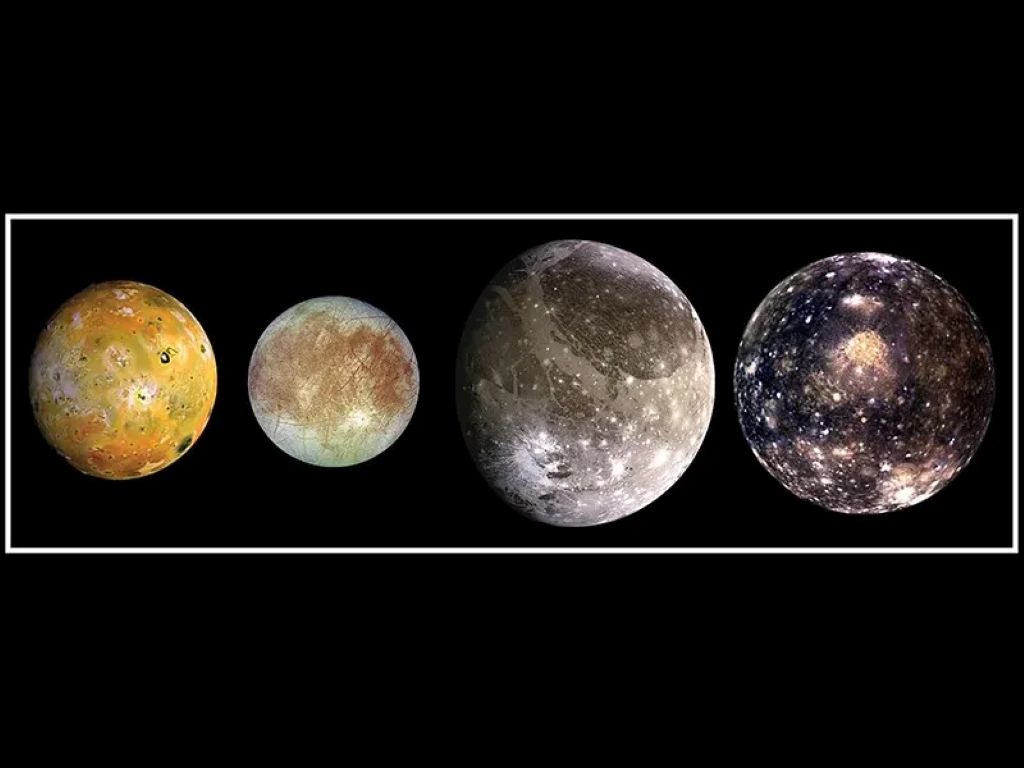
The King of the Planets might not have the most moons, but four of Jupiter’s 95 moons are definitely the easiest to see with a small pair of binoculars or a small telescope because they form a clear line. The Galilean Moons – Ganymede, Callisto, Io, and Europa – were first discovered in 1610 and they continue to amaze stargazers across the globe.
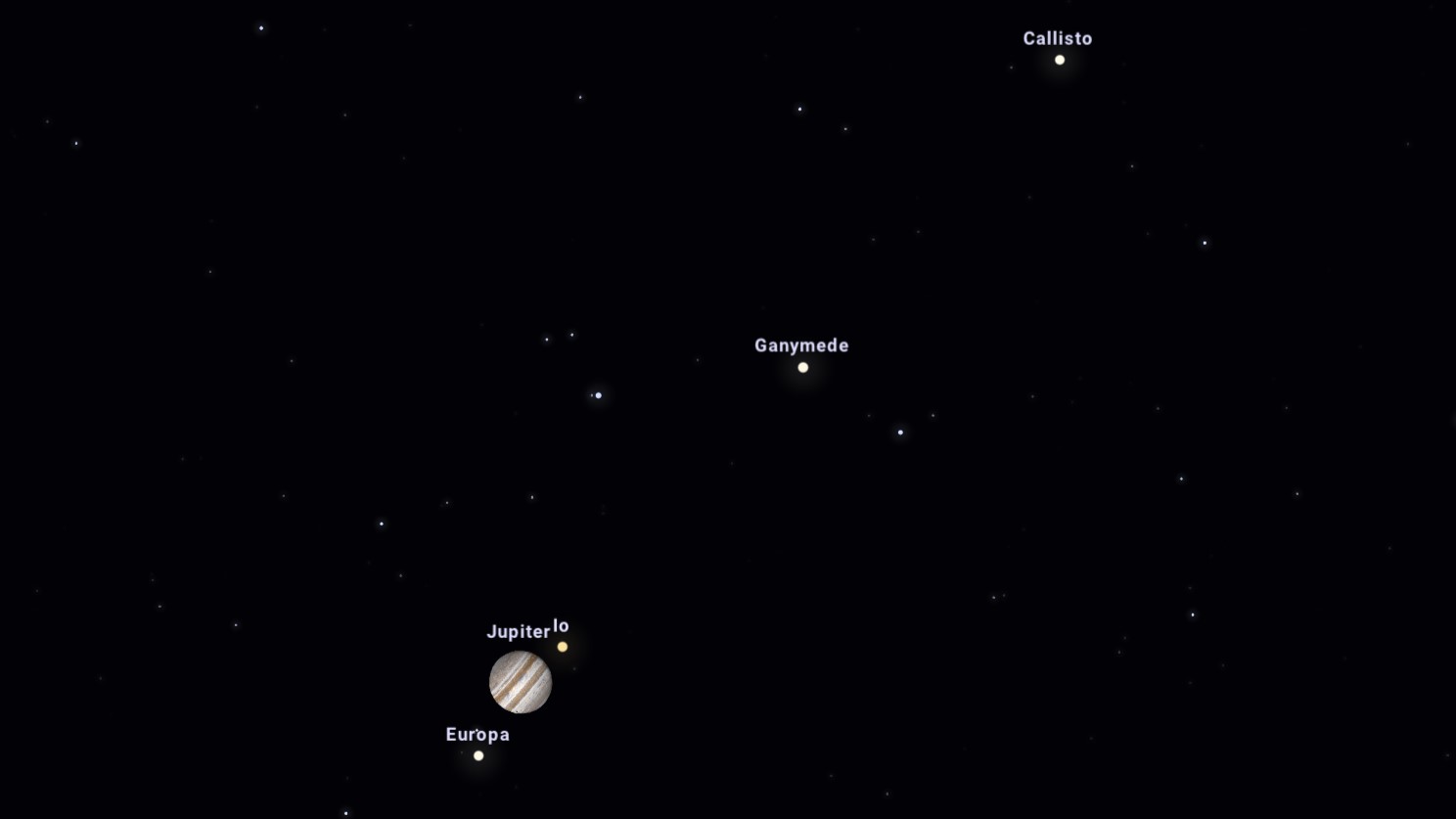
The Jovian system: Europa, Io, Ganymede, and Callisto.
Stellarium Web
- Ganymede: largest moon in our solar system, and larger than the planet Mercury, Ganymede has its own magnetic field and a possible saltwater ocean beneath the surface.
- Callisto: this heavily cratered moon is the third largest in our solar system. Although Callisto is the furthest away of the Galilean moons, it only takes 17 days to complete an orbit around Jupiter.
- Io: the closest moon and third largest in this system, Io is an extremely active world, due to the push and pull of Jupiter’s gravity. The volcanic activity of this rocky world is so intense that it can be seen from some of the largest telescopes here on Earth.
- Europa: Jupiter’s smallest moon also happens to be the strongest candidate for a liquid ocean beneath the surface. NASA’s Europa Clipper is set to launch October 2024 and will determine if this moon has conditions suitable to support life. Want to learn more? Rewatch the July 2023 Night Sky Network webinar about Europa Clipper here.
Be sure to celebrate International Observe the Moon Night here on Earth September 14, 2024, leading up to the super full moon on September 17th! You can learn more about supermoons in our mid-month article on the Night Sky Network page!
About The Author


Got a Questions?
Find us on Socials or Contact us and we’ll get back to you as soon as possible.